


Press release
July 28, 2026, No. 117
Alpine Pasture Course in the Isarwinkel Region: Alpine Pastures Caught Between Climate Change and Diverse Land Use
Nearly 30 experts from the fields of tourism, nature conservation, science, and agriculture discussed the future of alpine pastures
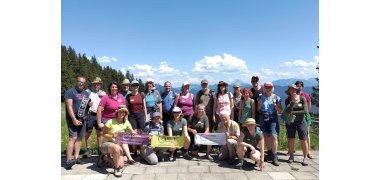
Bad Tölz-Wolfratshausen District. How can Bavaria’s alpine pastures be preserved in the long term as habitats, economic foundations, and recreational areas? This question was the focus of a two-day alpine pasture training course organized by the International Commission for the Protection of the Alps (CIPRA) (CIPRA) in collaboration with the Alpine Region Management Office of the Bad Tölz-Wolfratshausen District on June 19 and 20 in the Isarwinkel region. About 30 key stakeholders from the fields of tourism, nature conservation, science, and agriculture took part in the training session at the Schronbach, Stie, and Strasser alpine pastures in the Isarwinkel region (municipality of Lenggries).
The goal of the course was to provide practical knowledge about the ecological, agricultural, and tourism-related significance of alpine pastures. The focus was on alpine pastures as a cultural landscape and biodiversity hotspot, their sustainable management, and the impacts of climate change and increasing recreational use. At the same time, participants received suggestions on how to raise visitors’ awareness of treating nature with respect.
It became clear during the field trips that alpine pastures are much more than just popular tourist destinations. They are cultural landscapes that have evolved over centuries, and their species-rich open areas can only be preserved through appropriate management practices. At the same time, they ensure a supply of forage for agriculture, provide a habitat for numerous animal and plant species, and shape the landscape of the Alpine region.
At the Schronbach Alm, Sebastian and Uschi Bauer, together with herdsman Tom Lorscheter, presented their successful grazing concept, which features a sophisticated rotational grazing system. Biologist Albert Lang explained the diversity of habitat types and highlighted the close interconnections among species within the ecosystem. Susanne Krapfl, an alpine pasture consultant, provided information on alpine pasture farming in the district, as well as funding opportunities and the legal framework. Brigitte Meier introduced the Upper Bavarian Alpine Pasture Farming Association and addressed the challenges that structural change and climate change pose for alpine pasture farms.
In the evening, the workshop focused on the topics of tourism and visitor management. District Administrator Ludwig Schmid opened the series of presentations. Dr. Andreas Wüstefeld discussed the importance of tourism for the region and presented the campaign “Nature Conservation Starts with You.” Antonia Asenstorfer explained the role of the Brauneck Mountain Railway as a key partner for tourism in the Isarwinkel region. Christine Busch provided information about the work of CIPRA Germany, which is committed to the protection of the Alps and their sustainable development.
The second day of the training course took participants to the Brauneck tourist region. At the Strasser Alm, Hans Müller and Georg Mair, the long-time chairman of the Upper Bavarian Alpine Farming Association, emphasized that successful alpine farming requires comprehensive expertise, well-planned grazing management, and robust, sure-footed animals. At the same time, the decline in small farms is making the annual drive to the alpine pastures increasingly difficult due to a lack of suitable grazing livestock. Added to this are growing demands from tourism, forestry, and recreational activities such as hiking, mountain biking, and paragliding, which must be reconciled with alpine farming in a confined space.
Additional expert presentations were given by Prof. Jörg Ewald, dean of the Faculty of Forestry and Forest Management at HSWT, and Bernd Panassiti, a research associate at HSWT. Margret Hütt, area manager for the Bad Tölz-Wolfratshausen district, also explained the scenic and geological features of the Isarwinkel region.
The conclusion of the course was clear: The preservation of species-rich alpine pastures can only be achieved through the combined efforts of agriculture, nature conservation, tourism, and recreational use that is compatible with nature. Sustainable management, mutual understanding, and consideration are the key prerequisites for ensuring that alpine pastures can continue to fulfill their diverse functions in the future.
Sabine Schmid
Press spokeswoman
Bad Tölz-Wolfratshausen District Office