

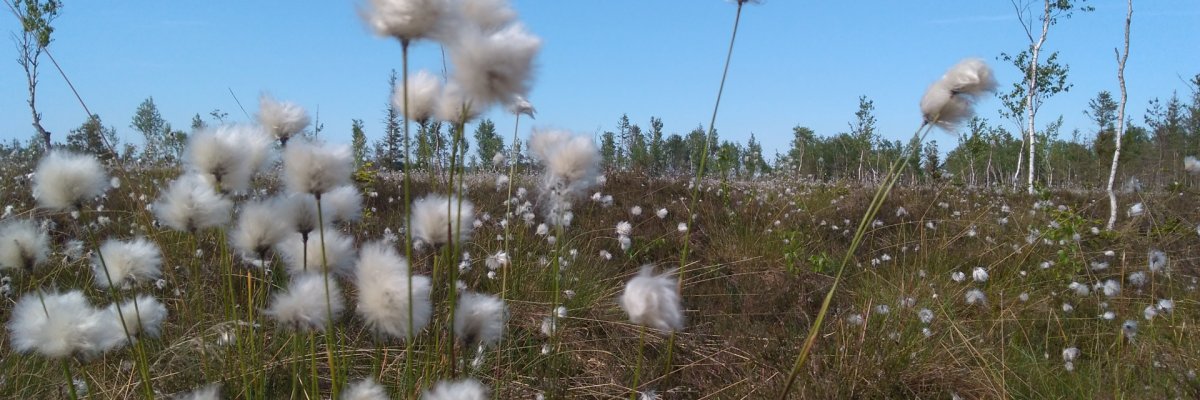
Tölz moor axis
A project to preserve our unique natural heritage.
12% of the area of the Bad Tölz-Wolfratshausen district lies on moorland. This unique moorland corridor stretches over a length of 30 kilometers and includes all types of moorland found in Germany.
The moors of the Tölzer Land stretch along an almost uninterrupted axis of 30 kilometers from Kochelsee to Deining. Many of these moorland areas still appear relatively natural. However, they are still in a critical ecological state due to historical drainage measures that are still effective today. For over 30 years, various stakeholders have been working to restore the moorland areas in the Tölzer Land region: the Center for Environment and Culture at Benediktbeuern Monastery (ZUK), the Bavarian Association for the Protection of Birds and Nature (LBV), the Bavarian Society for the Protection of Birds and Nature (LBV) and the Bavarian Society for the Protection of Nature (LBV).V. (LBV), Landschaftspflegeverband Bad Tölz-Wolfratshausen e.V. (LPV), Bund Naturschutz in Bayern e.V. (BUND), Bayerischer Bauernverband (BBV), the district of Bad Tölz-Wolfratshausen and the government of Upper Bavaria. In 2003, they joined forces to form the "Tölzer Moorachse" project group.
Peatland protection combines nature, species, soil and climate protection and is therefore of public interest. In addition, intact moors help to mitigate heavy rainfall events and floods, replenish groundwater and stabilize the local climate.
Overview map of moors in the district
In the environmental atlas of the Bavarian State Office for the Environment (LfU) you will find a representation of the moor areas in the district of Bad Tölz-Wolfratshausen with a legend.
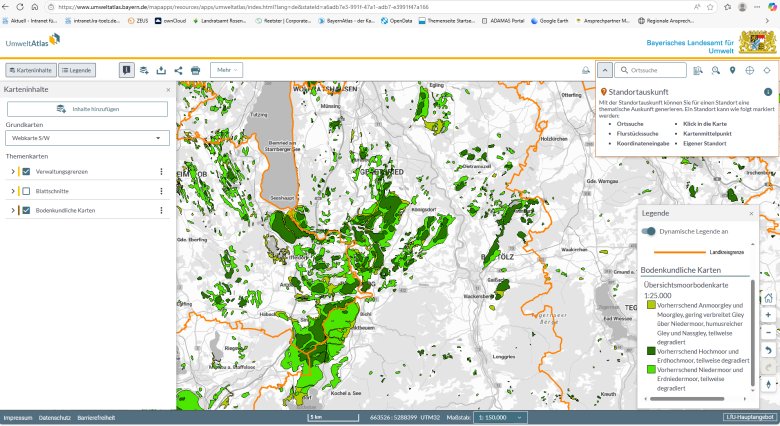 Bavarian State Office for the Environment, LRA TÖL
Mire protection = climate protection
Bogs form when plant growth is deposited and preserved as peat due to heavy moisture. In contrast, the drainage of peatland soil leads to aeration and, in the further course, to the decomposition of the peat.
In Bavaria, most moorland areas have been drained by drainage ditches or drainage systems in order to be able to use them for agriculture or forestry. This causes the peat originally preserved by water to decompose, releasing large quantities of climate-damaging greenhouse gases. In addition, the peat, which has grown over thousands of years, is lost.
Renaturation measures aim to restore the water balance in the moor and improve water retention. This can stop the decomposition of the peat and even encourage new peat formation. This binds carbon in the long term and creates a habitat for many rare animals and plants.
Restoring the water balance to renature raised bogs (felting) saves around 15 tonsof CO2 equivalents per hectare per year by preserving the peat substance, and around 30 tons ofCO2 equivalents per hectare per year in connection with grassland extensification (DRÖSLER 2009 and 2012). In addition to carbon dioxide, methane and nitrous oxide are the greenhouse gases occurring in peatlands. These are calculated together as CO2 equivalents to show their climate impact.
In addition to climate protection, peatland restoration has other important functions: rare habitats of endangered plant and animal species are preserved, groundwater and surface water quality improves and even flood peaks are reduced.
Literature:
DRÖSLER, M. (2009): What do peatlands have to do with the climate? - In: Laufener Spezialbeiträge 2/09: 60 - 68.
Preserving and restoring moorland: an important objective in the Tölzer Land region
The Tölzer Land region is home to some of the best-preserved wetlands in Central Europe. Nevertheless, many of these valuable moorland areas are in a critical ecological state.
The Free State of Bavaria makes it possible to finance moorland restoration measures with funding from the Landscape Conservation and Nature Park Guidelines (LNPR). The district of Bad Tölz-Wolfratshausen is responsible for land acquisition, leasing or registration of easements if owners wish to make their moorland available for renaturation.
Since the first renaturation measures in 1993, 372 hectares of moorland have already been specifically restored in the district. Of these, around 280 hectares have been successfully rewetted to restore the natural functions of the moors.
In the district of Bad Tölz-Wolfratshausen there are a total of 306 raised bog areas. Of these, 248 areas are still in an ecologically valuable state and worthy of preservation and are therefore particularly suitable for further renaturation projects. These moorland areas cover a total area of over 2,000 hectares.
Table: Overview of implementation measures andCO2 savings
Moorland
Effective renaturation area (ha)
Amount ofCO2 equivalents saved on the renaturation area (tCO2/ a)
Herrnhausen
0,25
5,6
Rough felt
1
15
Ebenberg felts
9
135
Zellbach valley
4
60
Münsinger felt
20
300
Sonnenhofer felt
4,6
69
Ellbach-Kirchsee-Moore
22
330
Königsdorf pasture felt
86
1290
Auer felt
20
300
Eglinger felt
23
345
Spatenbräu Felt
18
270
Höfner felt
20
300
Broad felt
50
750
Altenberg felts
4
60
Long and mowed moss
4
60
Schemer felt
6
90
Schellenberg Moor
2
30
Anger felts and new gardens
78
2340
Total
~ 372
~ 6750
Status: 10/2025
The restoration of 372 hectares of moorland in the district is already helping to reduce annual greenhouse gas emissions by more than 6,700 tons of CO2 equivalents. On around 2,000 hectares of non-agricultural raised bogs, there is potential to increase these savings fivefold in the future.
Moors are indispensable habitats for rare animal and plant species, important water reservoirs for our landscape and significant carbon stores in times of climate change.
Project examples of the Tölzer Moorachse
Rewetting measures in the Spatenbräu and Eglinger felts, in the Höfner Filz and in the Loisach-Kochelsee moors are helping to restore the original beauty and functions of the moorland landscapes. This will allow rare species such as cotton grass and butterflies such as the raised bog yellow butterfly to return to their original habitats. In addition to the overview of the implementation measures and their CO2 savings, you will find selected insights into individual projects here.
Mire restoration in the Auer Filz - an important step for nature and the climate
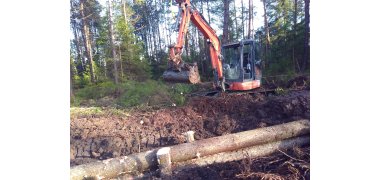 District Office Bad Tölz-Wolfratshausen
Since 2007, we have been working with the City of Munich and the "Tölzer Moorachse" steering group to protect the Auer Filz - a valuable moorland area. At that time, 42 dams were built as part of a renaturation measure to restore the natural water balance. In January and February 2026, old drainage ditches were closed on around 6 hectares on the edge of the Auer Filz. These ditches were created around 100 years ago to extract peat.
The closure means that the rainwater remains in the bog and the water levels rise. This allows the characteristic peat moss (Sphagnum) in the felt to gradually regenerate naturally. The renaturation measure contributes to the long-term improvement of the raised bog habitat and the storage of water and carbon.
Our moorland manager Elisabeth Pleyl ensures that moorland areas are preserved and their ecological functions are strengthened - always in close consultation with the owners. By restoring the moorland in Auer Filz, we are making a valuable contribution to protecting our unique natural environment and preserving our livelihoods.
 © efre-bayern.de / District Office Bad Tölz-Wolfratshausen
Herrnhausen
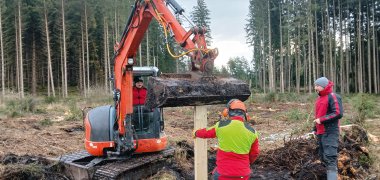 © F. Hartwich 2024Implementation of moorland protection measure November 2024 (F. Hartwich 2024)
Peatland protection can also be implemented on small and inconspicuous areas if there is a sufficient peat layer.
In the fen area of the municipality of Eurasburg (district of Herrnhausen), the peat condition is already severely impaired. Targeted water retention was therefore urgently needed to preserve the peat body. The decomposition of the peat was caused by earlier drainage measures such as ditches and drains, which were used for forestry purposes at the time.
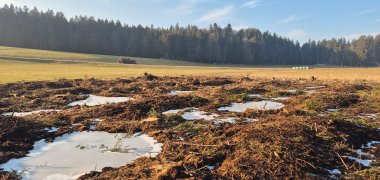 © F. Hartwich 2025Project area after implementation of measures
By closing the drainage ditches with peat-covered embankments and wooden bung cores as well as the prior removal of woody plants, the long-term formation of a new actrotelm (= peat formation zone) is made possible on this area. At the same time, a moist moor edge forest is being created, which serves as a refuge for rare animals and plants that depend on this habitat and thus complements the climate-relevant moor protection measures.
Contributors
The Tölzer Moorachse is an association of local nature conservation clubs and associations, representatives of the lower and higher nature conservation authorities, District Administrator Ludwig Schmid and a representative of the farmers. The project group has been working with landowners for 23 years to develop concepts for local moorland protection, secure areas and implement measures.
The members are: District Administrator Ludwig Schmid, Benedikt Zangl as representative of the Bavarian Farmers' Association (BBV), Father Karl Geißinger and Joachim Strobel from the Center for Environment and Culture in the Benediktbeuern Monastery (ZUK), Achim Rücker as representative of the Bavarian Federation for Nature Conservation (BUND), Sabine Tappertzhofen and Walter Wintersberger as office manager and district chairman of the State Association for Bird and Nature Conservation e. V. (LBV), Markus Henning as managing director of the Landscape Conservation Association Bad Tölz-Wolfratshausen e.V. (LPV), the bog managers Florian Hartwich and Elisabeth Hartwich. V. (LBV), Markus Henning as Managing Director of the Landschaftspflegeverband Bad Tölz-Wolfratshausen e.V. (LPV), the moor managers Florian Hartwich and Elisabeth Pleyl as well as Anne Nowottnick and Vroni Feichtinger from the higher nature conservation authority at the government of Upper Bavaria, and Franz Steger from the lower nature conservation authority at the Bad Tölz-Wolfratshausen district office.
Moorland protection as a state task
As part of the Bavarian state government's goal of achieving climate neutrality by 2040, peatland protection is being increasingly promoted due to its great potential for CO2 savings.
The implementation of moorland protection is therefore politically anchored in the following guidelines, among others:
- Peatland Master Plan (Council of Ministers resolution of 31.07.2018
Target: Reduction of greenhouse gas emissions from peatland soils by 1/3 by 2050 - Bavarian Climate Protection Act - BayKlimaG Article 3 (version: 23.11.2020)
Objective: To manage all state-owned land, especially peatland, in accordance with the BayKlimaG by 2030 - Government declaration Klimaland Bayern (21.07.2021)
Target: Rewetting 55,000 hectares of moorland by 2040 - Bavarian Climate Protection Program (2022)
Goal: Implementation of the Bavarian Climate Protection Act
Particularly relevant for peatland protection: Field of action 2 - NaturalCO2 storage - Council of Ministers decision (27.06.2023)
Determination of moorland protection as an overriding public interest - Confirmation of the peatland protection targets in the current coalition agreement (24.10.2023)
With our Bavarian Climate Protection Act and the Bavarian Climate Protection Program with around 150 measures, we have set ourselves ambitious targets in five key sectors. These must be further developed and natural climate protection, e.g. forests and moors, must also be strengthened.
Moors are multi-talented and store large amounts ofCO2. Their protection is of particular importance: we are committed to the goal of rewetting 55,000 hectares of moorland in Bavaria by 2040 together with landowners and users. We are continuing our moorland forest program and moorland farming program.
- Peatland Master Plan (Council of Ministers resolution of 31.07.2018
Contact for peatland restoration
Elisabeth Pleyl
Moor managerBad Tölz-Wolfratshausen District Office
Department 35 - Environment
Prof.-Max-Lange-Platz 1
83646 Bad Tölz
T: 8041 505-388
F: 8041 505-18-117
elisabeth.pleyl@lra-toelz.de
www.lra-toelz.deTuesday to Thursday 9.00 a.m. - 6.00 p.m. (also field services)
Friday by e-mail